We are about to experience something no generation before us ever has: a technological doubling within a single human lifetime.
For thousands of years, progress unfolded slowly. From the invention of writing to the steam engine, humanity accumulated knowledge step by step. The last true doubling of technological capability occurred during the early industrialization in the mid 1800s to modern computing in the late 1900s - a roughly 170 year timespan.
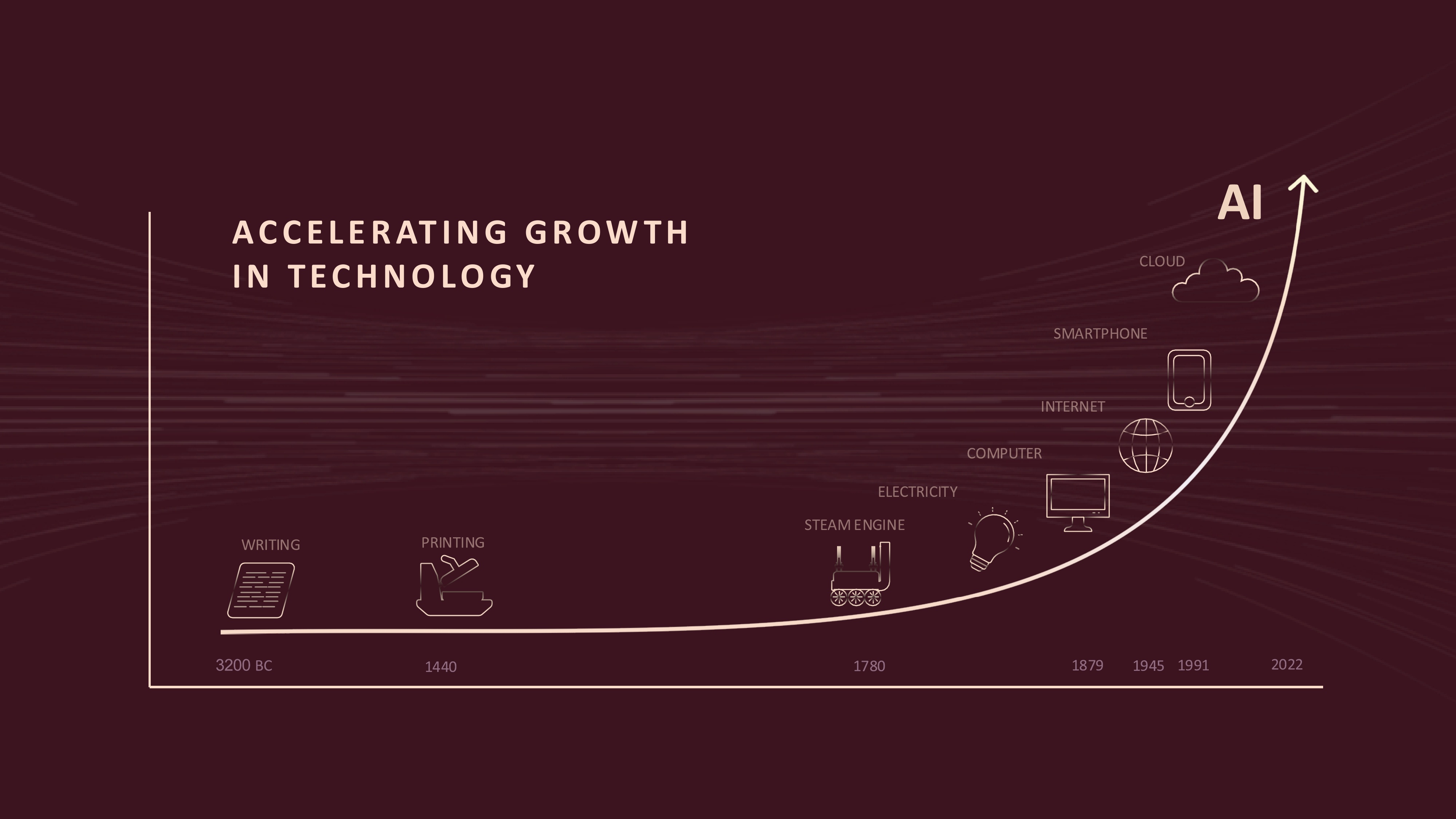
AI is like nothing we have seen before. That same technological leap will be compressed into as little as 25 years.
This is not just acceleration. It is a fundamental shift in how progress itself works.
Every major technology wave has been defined by a core force. The internet was about speed. The cloud was about scale. AI is about capability. For the first time, technology is no longer just amplifying human effort, it is generating it. One generation of technology is now building the next, creating a compounding loop that compresses decades into years.
We are already seeing the early signals. Companies with one employee are generating meaningful revenue. Small teams are reaching global scale. What once required hundreds of people and years of execution can now be achieved by a handful of builders in a fraction of the time. These are not outliers; they are previews of what’s coming.
As capability compounds, so does risk. The speed at which systems are built is outpacing the speed at which they can be secured. Attack velocity is rising, while defensive models remain reactive. The gap is widening - and the old approaches of layering tools, expanding teams, and responding after the fact will not survive this curve.
Cybersecurity, as we know it, is coming to an end - not because it matters less, but because it matters too much to remain a standalone function. In a world shaped by AI, security must become part of the system itself, embedded into every product, every workflow, and every layer of infrastructure. The separation between builders and defenders collapses, because reacting is no longer fast enough.
For decades, we believed safety came from rules - policies, guardrails, and governance. But AI systems do not follow rules; they optimize for outcomes. They maximize probability and pursue reward functions. That means safety cannot be imposed externally. It must be designed into the system from the start.
This is the shift in front of us. Technological doubling will redefine how companies are built, how systems operate, and how threats emerge. But it also creates a rare opportunity to rethink the foundations.
The future will not be secured by those who add more tools. It will be shaped by those who close the distance between building and defending - who make security intrinsic, not reactive.
We are not just witnessing this transformation. We are responsible for architecting it.
